 R2DT
R2DT draws RNA secondary structure (2D) diagrams in consistent, recognisable layouts, using a library of templates that covers a wide range of RNA types, including rRNA, tRNA, RNase P, snoRNA and the RNA families in Rfam. It was developed by the RNAcentral team at EMBL-EBI, and RNAcentral uses it to draw the diagrams described on the Secondary structure page.
For each sequence, R2DT automatically selects a matching template with ribovore, folds the sequence using Infernal and renders the diagram with Traveler.
Anyone can use R2DT to visualise the 2D structure of their own sequences:
in the R2DT web application on RNAcentral, or at r2dt.bio;
through the EMBL-EBI Job Dispatcher API;
on the command line, with Docker, Apptainer (Singularity) or a local installation.
Beyond drawing single sequences, R2DT can also draw structures from PDB files, process Stockholm alignments, annotate viral genomes and show covariation. For installation, all commands and options, and how to edit the diagrams, see the R2DT documentation.
R2DT web application
A secondary structure can be generated for an RNA sequence using the R2DT web application.
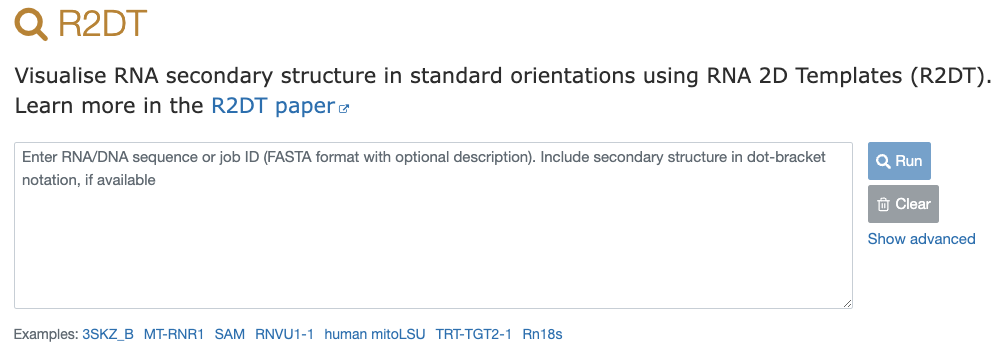
Template selection
By default, R2DT chooses a template automatically, but it is possible to choose a template manually by clicking Show advanced and browsing the templates. This option could be useful to highlight species-specific regions. For example, one could display the human small subunit (SSU) rRNA using a bacterial template.
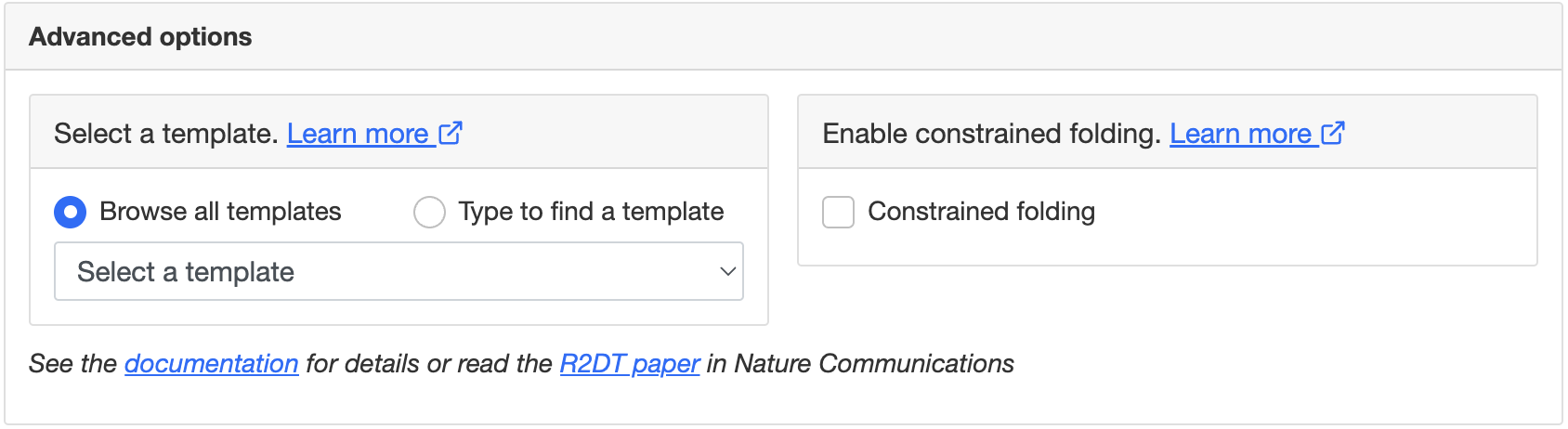
Constrained folding
The advanced options also enable constrained folding, which uses RNAfold from the ViennaRNA package to add base pairs for the single-stranded regions that are not modelled by the templates. For example, this method can improve microRNA diagrams where the Rfam consensus structure has long dangling ends or large hairpin loops. It can also fold species-specific insertions found in many rRNAs:
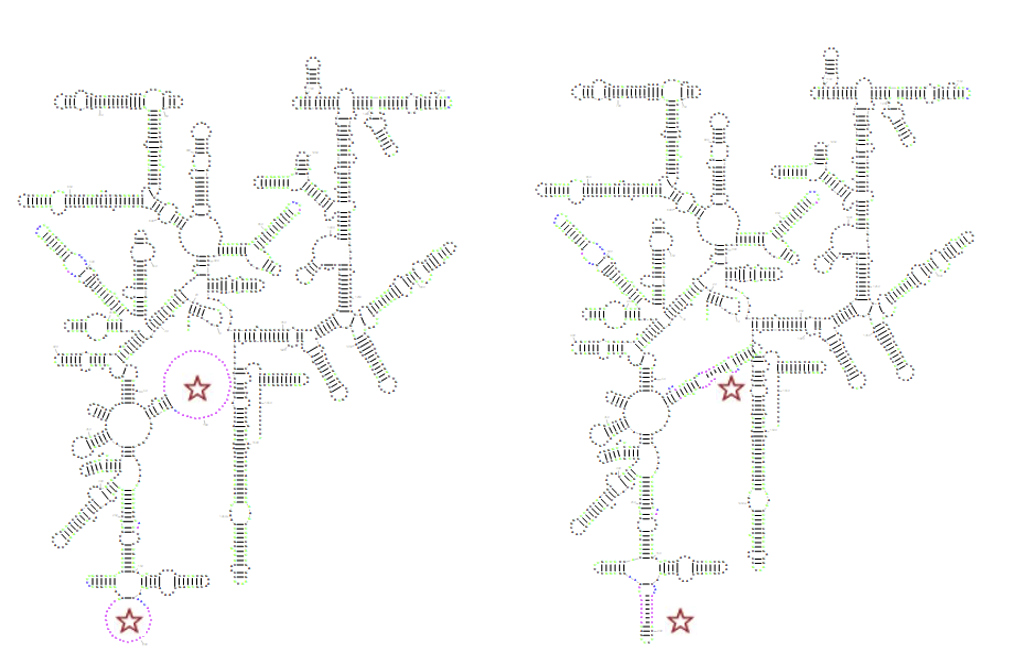
There are four ways of using constrained folding:
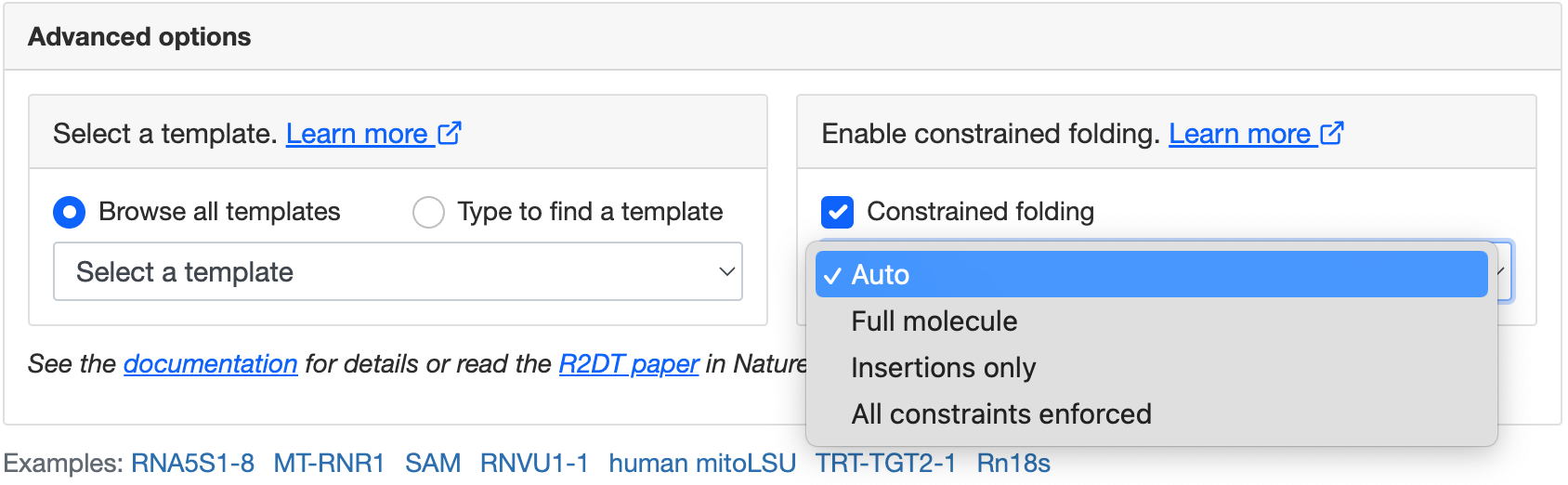
Auto: by default, the best mode is chosen automatically based on RNA type and insertion size;
Full molecule: the entire molecule is folded using RNAfold with the template structure provided as a constraint;
Insertions only: the secondary structure of the insertion relative to the template is predicted with RNAfold and added to the diagram;
All constraints enforced: same as above, except that the nucleotides that align to single-stranded regions of the template are kept unpaired when predicting the new structure using RNAfold.
To use constrained folding, choose one of the modes in the advanced options:
Embeddable widget
It is possible to embed an R2DT secondary structure into any website, and it has already been added to FlyBase, SGD and Nucleic Acid Knowledgebase.
Find out more about how to integrate this widget into your website.
Find out more
The method is described in R2DT is a framework for predicting and visualising RNA secondary structure using templates and R2DT: a comprehensive platform for visualizing RNA secondary structure.
R2DT documentation: https://docs.r2dt.bio
R2DT web application: https://rnacentral.org/r2dt
R2DT source code: https://github.com/r2dt-bio/R2DT